Why We Only Use Solid Hardwood (And What That Actually Means)
Walk into any big-box store or scroll through Amazon and you will see hundreds of toys marketed as "wooden." They look great in the listing photos. Some even feel decent when you pick them up. But flip one over, look at the edges, or scratch the surface, and you will quickly realize that most of them are not made from real wood at all.
At Goldman's Grain, every single product is built from solid hardwood. No plywood. No MDF. No particle board. No veneers hiding cheap material underneath. This is not a marketing angle. It is the entire point.
Here is what those terms actually mean, why the differences matter, and what we use instead.
Solid Hardwood vs. Everything Else
The toy and furniture industries use a handful of materials that sound similar but behave very differently. Understanding the differences will change the way you shop.
Solid Hardwood
A single piece of real wood, cut directly from a tree. It has natural grain, consistent density all the way through, and gets stronger and more beautiful with age. When you sand solid hardwood, you get more wood. When you scratch it, you can repair it. It can last generations because the material itself is durable at every layer.
Plywood
Thin layers of wood glued together with adhesive, with the grain of each layer running in alternating directions. Plywood is stronger than particle board and has legitimate uses in construction. But it is not solid wood. The layers can delaminate over time, especially with moisture exposure. The edges reveal the laminated layers and need to be covered or hidden. For toys, it is a cost-cutting measure dressed up as a material choice.
MDF (Medium-Density Fiberboard)
Sawdust and wood fibers compressed with resin and adhesive into flat sheets. MDF has no grain, no character, and no structural integrity once it gets wet. It swells, crumbles, and cannot be repaired. More importantly, conventional MDF uses urea-formaldehyde resin as a binding agent. Formaldehyde is a known carcinogen, and it off-gasses from MDF products, particularly when they are new. This is the material inside many mass-produced "wooden" toys.
Particle Board
Even lower grade than MDF. Wood chips, shavings, and sawmill scraps glued together under pressure. It is the cheapest engineered wood product and the least durable. It chips, crumbles at the edges, and cannot hold fasteners well. If a toy feels surprisingly light for its size, there is a good chance it is particle board with a printed veneer on top.
"Engineered Wood"
This is the catch-all marketing term that covers everything from plywood to MDF to particle board. When a toy brand says "engineered wood" without elaborating, they are almost always describing one of the materials above with a nicer label. If a company used solid hardwood, they would say so.
The Safety Problem Nobody Talks About
Most parents focus on whether a toy is labeled "non-toxic," but the real question is what the toy is made of before it gets painted or coated.
MDF and particle board contain formaldehyde-based adhesives that off-gas volatile organic compounds (VOCs) into the air. These emissions are highest when the product is new, which is exactly when most parents unbox a toy and hand it to their child. For babies and toddlers who put everything in their mouths, this is not a theoretical concern.
Then there is the paint and finish layer. Mass-produced toys often use lacquer or polyurethane coatings to create a glossy, colorful surface. These finishes can chip, and when a child chews on a painted MDF toy, they are potentially ingesting both the coating and the substrate underneath.
Solid hardwood sidesteps these problems entirely. There is no adhesive holding the material together because it is one piece of wood. And when you finish it with a food-safe oil instead of paint or lacquer, there is nothing on the surface that should not be in a child's mouth.
The Four Woods We Build With
Goldman's Grain uses four North American hardwood species. Each one is chosen for specific reasons: grain, strength, beauty, and how it ages over decades. You can see all four in detail on our woods page.
Hard Maple
Light in color with a fine, tight grain. Hard maple is one of the densest domestic hardwoods, which makes it exceptionally durable and smooth to the touch. It is the primary wood for our building blocks, name signs, and kitchen items. Over time, it ages to a warm honey tone that only gets better.
Black Walnut
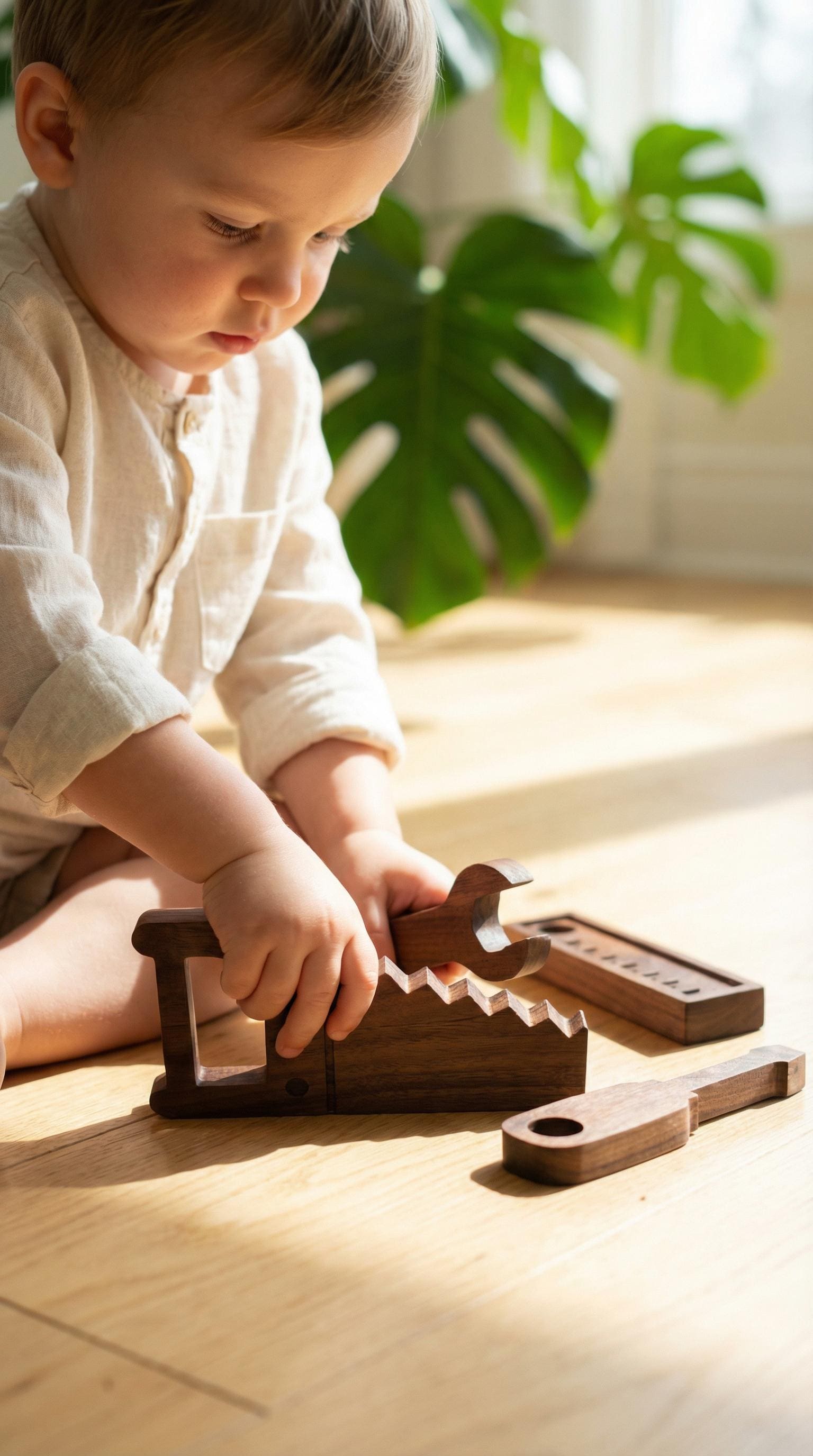
Deep brown with rich, dramatic grain patterns. Walnut is a premium hardwood that feels substantial in the hand. It is the wood behind our kids' tool sets and many of our building block collections. When a two-year-old picks up a walnut hammer, they can feel that it is real.
Black Cherry
A warm reddish-brown that deepens and darkens with exposure to sunlight. Cherry is the wood that visibly earns its heirloom status. A cherry toy made today will look meaningfully different in ten years, with a rich patina that tells you it has been loved and used.
White Oak
Bold grain with a golden tone and serious structural strength. White oak has been the backbone of American woodworking for centuries, and for good reason. It holds up to heavy use, resists moisture better than most hardwoods, and looks beautiful doing it.
Why Food-Safe Oil (And Why It Matters)
Every Goldman's Grain product is finished with a food-safe oil and wax blend. No polyurethane. No lacquer. No spray-on mystery coatings.
A food-safe oil finish penetrates the wood fibers rather than sitting on top as a plastic-like film. This means the surface you touch is still wood, not a synthetic layer over wood. It feels warmer, it smells like real wood, and most importantly, it is safe if a child puts it in their mouth.
The trade-off is that an oil finish requires slightly more care over the years. It can be refreshed with a light coat of mineral oil or beeswax, which takes about two minutes. In return, you get a toy that never peels, never chips, and never develops that cracked, yellowed look that lacquered toys get after a few years.
You can read more about our finishing process and how we build each piece on the How It's Made page.
What to Look for When Shopping
If you are shopping for wooden toys, here are the questions worth asking:
- Does the listing say "solid wood" or just "wood"? Vague language usually means engineered materials.
- Can you see natural grain in the photos? Real hardwood has visible, unique grain patterns. MDF and particle board have none.
- What species of wood is it? If the listing does not name a specific species (maple, walnut, cherry, oak, etc.), it is likely not solid hardwood.
- What finish is used? Look for "food-safe," "mineral oil," "beeswax," or "tung oil." Avoid toys that list only "non-toxic paint" without specifying the substrate.
- Where is it made? Handmade pieces from small shops are far more likely to use real materials than mass-produced imports.
Ready to See the Difference?
Every Goldman's Grain product is built from solid hardwood in Raleigh, NC. Maple, walnut, cherry, and oak -- finished with food-safe oil and built to last generations.