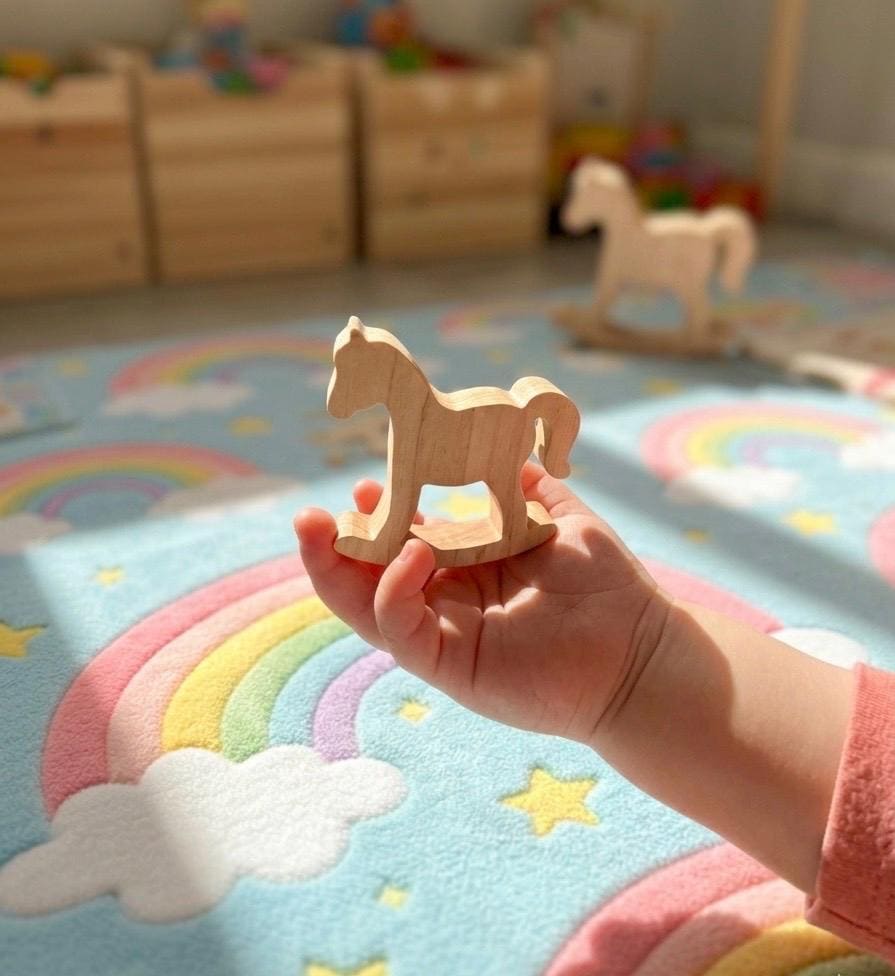
Watch a two-year-old pick up a wooden animal figure and you will see something remarkable happen almost immediately. The figure is no longer just a carved piece of maple. It is a character. It has a name. It is hungry, or scared, or going on an adventure. The child is not just playing — they are building a world.
We tend to dismiss this as "just playing." Developmental science disagrees. Strongly.
Over the past several decades, researchers studying how children learn have arrived at a striking consensus: pretend play — the kind where a child assigns imaginary roles, invents scenarios, and acts out stories — is one of the most cognitively demanding and developmentally important activities a young child can engage in. It is not a break from learning. It is one of the primary ways children learn to be human.
What Pretend Play Actually Is
Developmental psychologists use the term "symbolic play" or "sociodramatic play" to describe what most of us simply call pretend play or make-believe. It typically begins to emerge around 18 months to 2 years of age, when children start to understand that one object can stand in for another — that a wooden block can be a car, that a toy figure can be a person with feelings and intentions, that an imaginary cup can hold imaginary tea.
This capacity for symbolic thinking is considered a cognitive milestone as significant as walking or talking. It signals that a child's brain has developed the ability to hold two realities simultaneously: what something actually is and what it is pretending to be. That mental flexibility, researchers have found, is a foundation for nearly every higher-order thinking skill that follows.
The Research: What Pretend Play Does for a Child's Brain
Language and Vocabulary
One of the most well-documented benefits of pretend play is its effect on language development. When children engage in make-believe — especially with other children or with a parent — they use more complex sentence structures, more diverse vocabulary, and more sophisticated narrative grammar than they do in ordinary conversation.
Dr. Sandra Russ of Case Western Reserve University, one of the leading researchers on play and child development, has spent decades studying how pretend play relates to cognitive and emotional functioning. Her research consistently shows that children who engage in richer, more imaginative play demonstrate stronger verbal and narrative skills. They are better at telling stories with a beginning, middle, and end — and that storytelling ability, she argues, is directly linked to reading comprehension and later academic performance.
A landmark 1990 study by Kathleen Galyer and Anne Evans found that children who participated in structured pretend play sessions showed significantly greater gains in expressive language compared to control groups. The play was not structured in a rigid way — it was simply facilitated, with props and space to invent stories. The gains were meaningful enough that play-based language interventions are now a standard component of early childhood speech therapy.
Executive Function
Perhaps the most compelling area of pretend play research is its relationship to executive function — the cluster of cognitive skills that include self-regulation, impulse control, working memory, and cognitive flexibility. These are skills that predict academic success better than IQ, and they are skills that many children today are struggling to develop.
The pioneering work of developmental psychologist Lev Vygotsky in the early twentieth century laid the groundwork for understanding why. Vygotsky observed that when children engage in pretend play, they voluntarily impose rules on themselves. A child playing "house" follows the rules of the role — the "parent" does not behave like a child. A child playing "doctor" stays in character. This self-imposed rule-following, Vygotsky argued, is one of the earliest and most natural forms of self-regulation a child practices.
More recent research by Dr. Adele Diamond of the University of British Columbia, a leading authority on executive function in early childhood, has reinforced this connection. Diamond's work shows that children who engage in more pretend play — particularly complex, multi-player pretend play — demonstrate stronger executive function skills, including better impulse control and greater working memory capacity. In one of her key papers, she argues that the demands of maintaining a pretend scenario (remembering the rules, staying in character, coordinating with other players) are a natural training ground for the prefrontal cortex.
"Play is the work of childhood." — Jean Piaget, developmental psychologist
Emotional Intelligence and Empathy
When a child acts out a story in which a character is scared, or sad, or left out, they are not just performing an emotion — they are practicing it. They are building what researchers call "theory of mind": the understanding that other people have thoughts, feelings, and perspectives different from their own.
Theory of mind typically emerges between ages 3 and 5, and research has consistently shown that children who engage in more pretend play develop it earlier and more robustly. A 2006 study by Paul Harris at Harvard Graduate School of Education found a direct correlation between the amount of fantasy play a child engaged in and their performance on theory-of-mind tasks. Children who pretended more were better at understanding what another person was thinking or feeling — a skill that forms the basis of empathy, social competence, and emotional regulation throughout life.
Dr. Stuart Brown, founder of the National Institute for Play and author of Play: How It Shapes the Brain, Opens the Imagination, and Invigorates the Soul, argues that play deprivation — the chronic absence of imaginative, open-ended play — is associated with increased aggression, social difficulty, and emotional dysregulation in children. Brown spent decades researching the play histories of violent criminals and found a striking pattern: almost all of them had severely impoverished play histories in childhood. While pretend play alone is not a guarantee of emotional health, its absence appears to carry real risk.
Creativity and Problem-Solving
Sandra Russ's longitudinal research, which followed children over multiple years, found that children who demonstrated richer imaginative play at age 6 and 7 were more creative and better at problem-solving years later — even controlling for IQ. The quality of a child's pretend play, she found, was one of the best early predictors of creative thinking in adulthood.
This makes intuitive sense. Pretend play is fundamentally a creative act. A child who invents a story with no script, no instructions, and no guaranteed outcome is practicing the exact cognitive process that produces creative solutions in adult life: generating possibilities, testing them mentally, adjusting when they do not work, and finding satisfaction in the result.
What the American Academy of Pediatrics Says
In 2018, the American Academy of Pediatrics (AAP) published a clinical report titled "The Power of Play: A Pediatric Role in Enhancing Development in Young Children." The report's conclusions are worth quoting directly: the AAP called play "essential to the cognitive, physical, social, and emotional well-being of children and youth" and stated that pediatricians should actively prescribe play as part of well-child visits.
The report specifically highlighted child-driven, imaginative play — as opposed to adult-directed activities and screen-based entertainment — as the most developmentally valuable form. It noted that the decline of unstructured play time in recent decades, driven by increased academic pressure, overscheduling, and screen time, is a genuine public health concern.
Why Simple Toys Support Richer Pretend Play
Here is something that research on toys and play consistently shows: the simpler the toy, the richer the pretend play it supports.
A toy that does something — that lights up, makes sounds, has one correct way to be used — directs the child's attention toward the toy's behavior. The child becomes a spectator. A toy that does nothing on its own — a wooden animal figure, a set of blocks, a simple tool set — demands that the child supply everything: the story, the character, the rules, the meaning. The child becomes the creator.
Dr. Dimitri Christakis of Seattle Children's Research Institute has studied this dynamic extensively. His research shows that children playing with simple, open-ended toys produce significantly more complex vocalizations and imaginative narratives than children playing with feature-rich electronic toys. The electronic toy fills the silence. The wooden toy invites the child to fill it themselves.
This is one of the core principles behind Montessori toy philosophy, and it is why solid hardwood toys — animal figures, tool sets, building blocks, rocking horses — have been a staple of early childhood development for generations. They are not just beautiful objects. They are deliberately unfinished invitations for a child's imagination to complete.
What You Can Do to Support Pretend Play
The research points to a few practical things parents can do:
- Protect unstructured time. Children need blocks of time with nothing scheduled, no screens, and no adult agenda. Boredom is often the precondition for imaginative play.
- Choose open-ended toys. Blocks, figures, simple vehicles, and basic props support richer pretend play than toys with one built-in purpose. The fewer buttons, the better.
- Play alongside them — without taking over. Children whose parents occasionally join their pretend play show richer imaginative scenarios, but only when the adult follows the child's lead rather than directing the story.
- Limit screen time during peak play years. The AAP and most child development researchers recommend strict limits on screen time for children under 5, particularly during the hours that would otherwise be spent in imaginative play.
- Provide real-world props. Children are drawn to objects that feel real. A solid walnut tool set that actually has weight and grain tells a child's nervous system something true about the world. It invites play in a way a hollow plastic replica simply cannot.
The toys that invite the most play are the ones that do the least — and ask the child to do the rest.
The Bottom Line
Pretend play is not a luxury. It is not something children do while waiting to get to the real learning. It is the real learning — the mechanism through which children develop language, emotional intelligence, self-regulation, creativity, and social competence. Decades of research from developmental psychologists, neuroscientists, and pediatric organizations support this clearly and consistently.
The best thing you can give a young child is not a toy that teaches. It is a toy that invites. A beautiful, simple, solid object that a small hand can pick up, turn over, and decide what it is going to be today.
That is what a well-made wooden toy does. It gets out of the way and lets the child's imagination do the work that matters most.
Toys That Invite Imagination
Goldman's Grain animal figures, tool sets, and building blocks are made from solid hardwood — simple by design, built to last generations of play.